 (Image source: Gemini)
 You’ve landed at Keflavík, and you’re ready to see the blue ice and the black sands you’ve seen on every travel blog for the last decade. But when you try to book that bucket-list glacier hike, you find a digital "sold out" sign. For years, Iceland was the place where you could show up and explore. Those days are officially over. As of 2026, the Icelandic government has pulled the emergency brake on unrestricted access to its most famous natural wonders. So, what’s actually happening? It’s a massive shift in how the country handles its visitors. We’re moving away from the old "more is better" mindset. Now, it’s all about managed access and keeping the environment from falling apart. If you’re planning a trip, you’ll need to think of it like booking a popular concert. You can’t just wing it anymore.
The Current State of Icelandic Tourism
Iceland has been riding a tourism wave that won't quit. After the pandemic, everyone seemed to have the same idea: get to the Land of Fire and Ice before the glaciers melt. In 2024, the country saw around 2.26 million international visitors. By 2025, that number hit a record 2.32 million.¹ It’s a lot for a nation of fewer than 400,000 people. You can feel the pressure at every gas station and every trailhead.
The economic side of this is huge. Tourism brings in 8.5% of the country’s GDP. It employs roughly 35,000 people. That’s nearly 10% of the population. But the government realized they were trading their long-term survival for short-term cash. The sheer volume of people was starting to eat away at the very thing everyone came to see.
The new visitor caps represent a total rethink of how a country hosts the world. You’ll see this most clearly in the national parks. Access is now managed through digital permits and timed-entry requirements. It’s like a digital velvet rope. It keeps things moving but stops the environment from getting crushed.
Why Glaciers Are the Canary in the Coal Mine
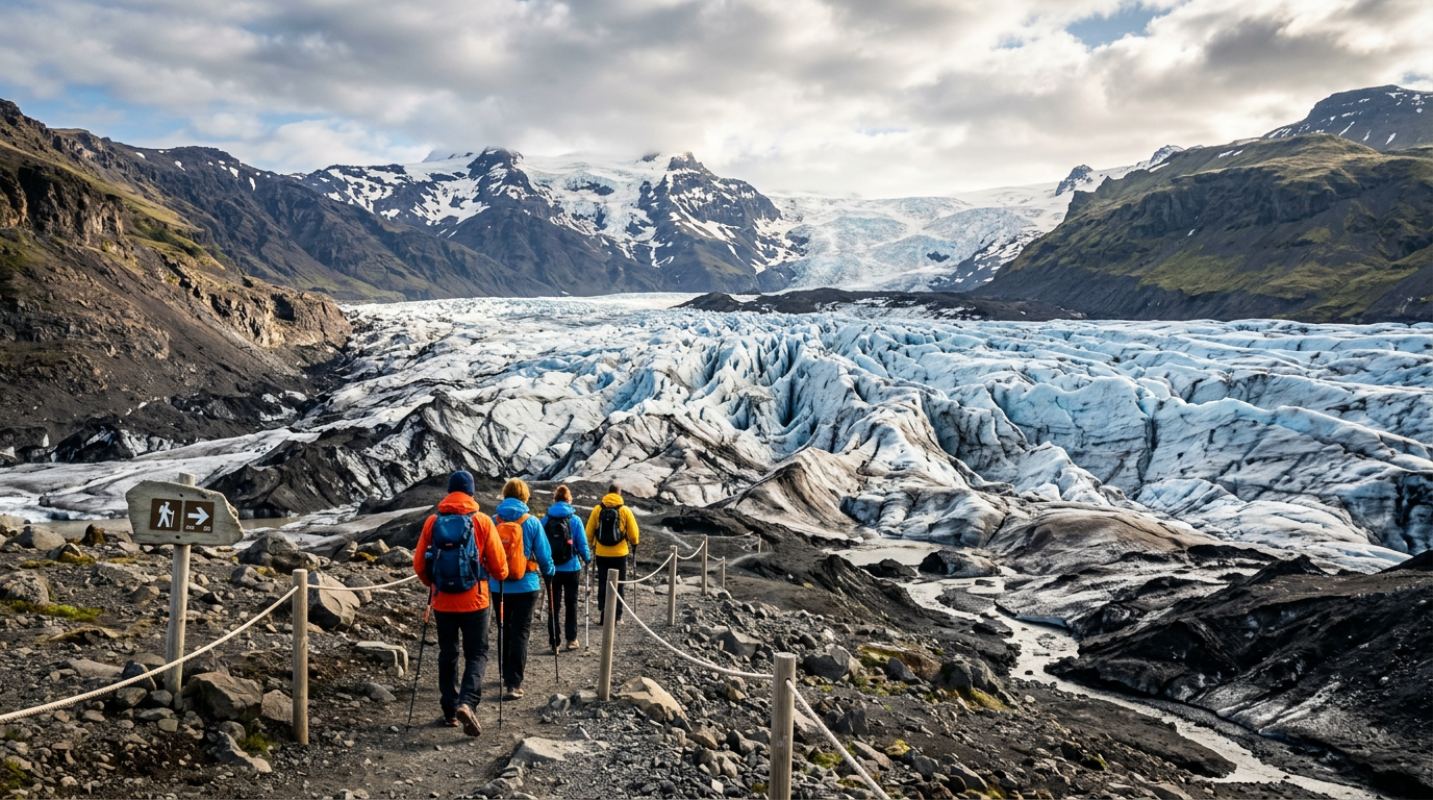
Why the sudden urgency? It mostly comes down to the ice. Glaciers are incredibly sensitive. They’re basically the canary in the coal mine for the planet's health. Turns out, people are the problem. Reports have been piling up about erosion and damage to paths that were never meant for thousands of feet every day.
The turning point was a horrific accident on August 25, 2024. An ice arch collapsed at the Breiðamerkurjökull glacier during a guided tour. It killed an American tourist and seriously injured another. That event shook the industry to its core. It proved that the "last-chance tourism" rush was pushing people into dangerous situations.
Beyond the safety risks, the environmental damage was getting weird. Some tour operators were actually caught digging artificial tunnels and caves to make sure they had something to show tourists. That’s permanent structural damage to the ice. Then there’s the moss. Icelandic moss is beautiful, but it’s fragile. If you step on it, it can take decades or even centuries to grow back.
To manage this, Iceland now uses a "Sustainability Balance Check" system. Think of it like a traffic light for nature.
- Green: Everything is fine. Explore away.
- Yellow: The site is getting stressed. Expect some restrictions.
- Red: The site is closed. This has been happening a lot at the Fjaðrárgljúfur canyon and parts of the Highlands to let the soil and moss recover.
The New Daily Caps
If you’re heading out this year, you need to know the numbers. The caps are strict, and they’re enforced. In the southern part of Vatnajökull National Park, the daily quotas for glacier activities are now set in stone.
- Breiðamerkurjökull: Limited to 650 visitors per day for both the East and West sides.
- Falljökull and Virkisjökull: These can handle a bit more, with a cap of 1,000 visitors per day.
- Skeiðarárjökull and Skálafellsjökull: These are limited to 500 visitors per day each.
At Þingvellir, which is part of the famous Golden Circle, the crowds can hit 5,000 people a day in the summer. To fix this, authorities are using parking limits and timed bus access. You can’t pull over whenever you want. You have to have a slot.
The booking system is mostly digital now. You’ll likely get your permits through an app or the official park websites. If you don’t have one, you’re not getting in. It sounds like a headache, but it actually makes the experience better. You aren't fighting through a sea of selfie sticks to see a waterfall.
How to Visit Iceland Without Leaving a Trace
You’ve probably heard the phrase "take only photos, leave only footprints." In Iceland, even the footprints can be a problem. Staying on marked paths is the most important thing you can do. Those little ropes and barriers aren't suggestions. They’re there because the ground under your feet is often a thin layer of life over volcanic rock.
Supporting local, low-impact tour operators is another key move. The new regulations for the 2025/2026 season are very specific about this.
- Mandatory Guides: You can’t go into ice caves alone anymore.
- Group Limits: Guides are limited to 8 to 16 guests, depending on how stable the cave is.
- Risk Assessments: Operators have to share safety data every single day before they can take anyone out.
You should also try to embrace "slow travel." Instead of trying to see the whole island in five days, pick one region and stay there. It reduces your carbon footprint and helps ease the congestion on the main ring road. Plus, you’ll actually get to know the place instead of just seeing it through a car window.
A Sustainable Path for the Land of Fire and Ice
So, is this the end of the Iceland we knew? In a way, yes. But that’s a good thing. These restrictions are designed to make sure the glaciers and the moss are still there for your kids to see. It’s a tough balance between needing the money from tourism and wanting to protect the environment.
The establishment of the Nature Conservation Agency of Iceland in early 2025 shows how serious the government is. They’ve even brought back the tourism tax. You’ll pay about ISK 600 per room at hotels and ISK 1,000 if you’re coming in on a cruise ship. This money goes directly into fixing the trails and protecting the sites.
The relationship between travelers and fragile places is changing. We have to be guests who actually care about the house we’re visiting. If Iceland can make this work, it might become the model for every other destination struggling with overtourism. It’s about making sure that "last-chance tourism" doesn't actually become the last chance.