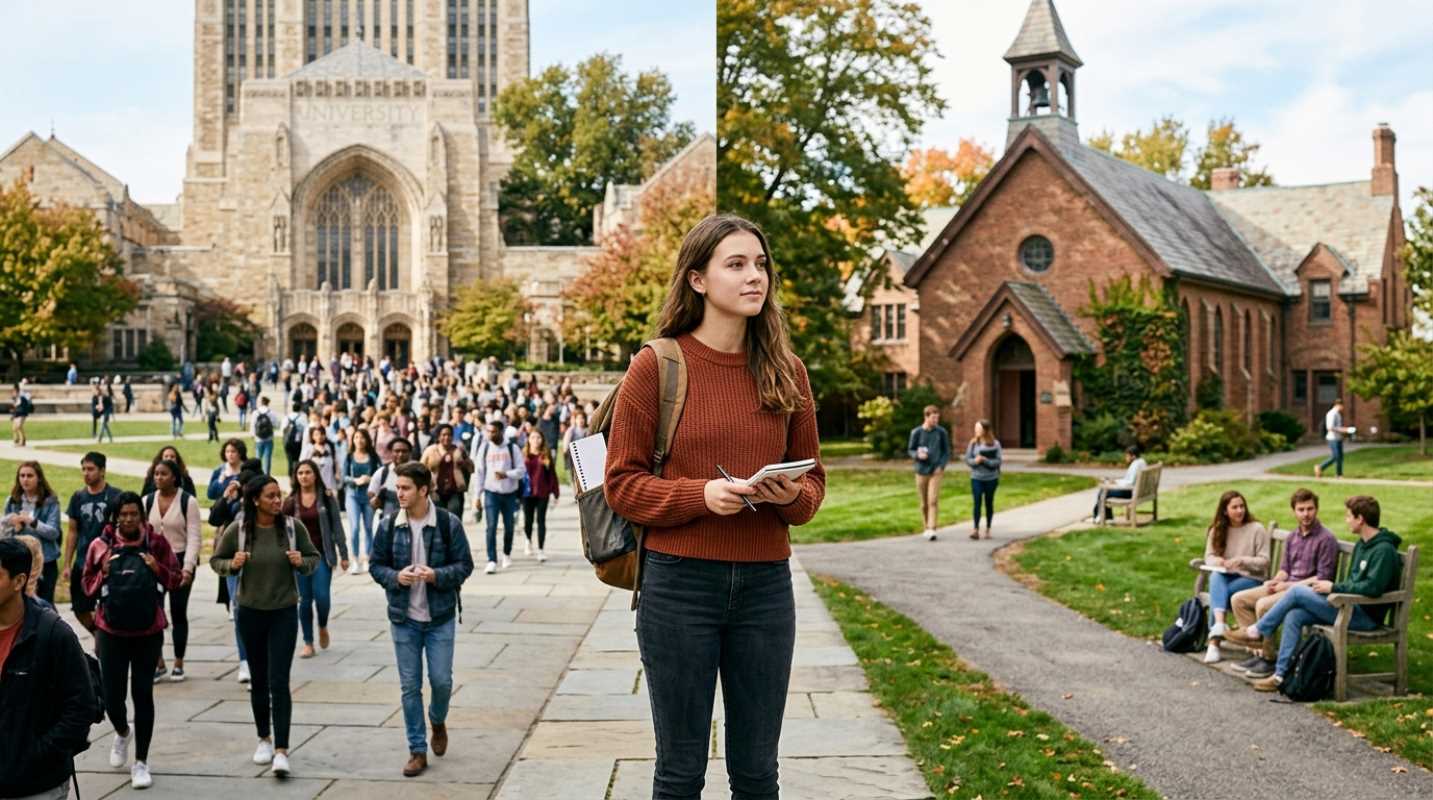
Staring at a pile of college acceptance letters can feel a lot of. You have a stack of glossy brochures on your desk, each promising the best four years of your life. One brochure highlights a bustling campus with packed stadiums and massive research labs. Another shows a quiet quad with small discussion circles sitting under oak trees.
How do you actually decide between these two worlds?
At its core, the choice comes down to scale and environment. Large universities usually house over 15,000 students, offering massive research facilities and endless academic choices. Small colleges, typically under 5,000 students, focus heavily on undergraduate teaching and personal mentorship.
Rankings like to push a single narrative about prestige, but prestige will not help you if you end up in an environment where you struggle to learn. The real goal is finding a place where you will do your best work and feel at home.
Introduction The Great Campus Debate
When you strip away the marketing photos, big universities and small colleges offer fundamentally different daily experiences. Big schools offer broad options and high energy. Small schools offer depth, connection, and focused attention.
Neither option is better across the board. A student who feels energized by a 30,000-person campus might feel suffocated at a small liberal arts college. Meanwhile, a student who wants direct relationships with professors might feel lost in a 300-person lecture hall.
To make the right call, you need to look past brand names. You need to look at how you handle learning, socializing, and building your future.
The Intimacy Factor Comparing Class Sizes and Campus Culture
Think about how you learn best. Do you like to sit back and process information quietly, or do you prefer to speak up, debate, and ask questions out loud?
At a big university, your introductory lectures might hold 100 to 300 students. In those huge lecture halls, staying anonymous is easy. Graduate teaching assistants often grade your exams or lead weekly discussion sections. Upper-level courses do get smaller, dropping down to 25 or 50 students, but you still have to take the initiative if you want your professor to know your name.
Small colleges flip this setup entirely. Average class sizes hover between 10 and 20 students. Discussions follow an interactive format where active participation is expected every single day. Full-time professors teach almost all courses, not graduate students. If you skip a class, your professor notices. If you skip the assigned reading, everyone in the room knows it.
This dynamic shapes campus culture as well. At a small school, you get a tight community where you recognize almost everyone walking to the dining hall. On a huge campus, you act more like a resident in a major city. You can reinvent yourself each semester, join sprawling subcultures, or spend Saturdays shouting alongside thousands of fans at athletic games.
The close support of smaller schools shows up in completion numbers, too. Private non-profit colleges reach an average six-year graduation rate around 76%, while public four-year universities average closer to 71%.¹
Weighing Resources at Large vs Small Schools
Resource distribution looks completely different depending on institutional size. It is not just about who has more money in total, but who actually gets to use it.
Large research universities offer an incredible variety of academic tracks. You might find 80 to 150 specialized majors ranging from aerospace engineering to supply chain management. They build state-of-the-art facilities, operate multi-million-dollar research centers, and secure heavy research funding. The tradeoff? Undergraduates frequently compete with master's and Ph.D. candidates for lab space and faculty time.
Small colleges typically offer 30 to 50 broader majors like physics, English, or political science. What they lack in hyper-specialized degree titles, they make up for in direct access. Because there are no graduate students ahead of you, undergraduate students get direct research opportunities starting right in their first or second year.
Career outcomes show interesting patterns across different timeframes
• Short-term return on investment: Big research schools often give graduates an early edge in entry-level earnings. Specialized technical degrees like computer science or engineering deliver strong starting salaries, often ranging from $77,000 to $80,000 right out of school.
• Long-term career growth: Graduates from small colleges frequently catch up and out-earn their peers over a 20- to 40-year career. The heavy focus on writing, complex problem-solving, and adaptability helps these graduates move into management, executive roles, and advanced degrees later in life.
• Job market stability: In a competitive hiring market, career preparation matters. Recent job survey data shows graduating seniors are submitting more applications to secure position offers, with offer acceptance rates climbing to 86.7%.² Having personal references from faculty can help you stand out.
Choosing Based on Learning Style and Personality
So how do you figure out where you fit best? Take an honest look at how you operate day to day.
You will likely thrive at a small college if
• You prefer interactive learning: You learn best through direct dialogue, writing assignments, and debate rather than passive listening.
• You want professor mentorship: You value having faculty members who know your personal goals and keep you accountable.
• You want early hands-on research: You want to work directly in labs or field projects without waiting behind graduate students.
• You like close communities: You enjoy knowing your peers and feeling connected across a smaller campus.
You will likely thrive at a big university if
• You are highly self-directed: You handle large systems well, direct your own schedule, and actively seek out help on your own.
• You want a specialized major: You already know you want niche programs like game design, aviation, or biomedical engineering.
• You are a proactive networker: You feel comfortable visiting office hours, applying for competitive internships, and creating your own opportunities.
• You want constant variety: You want high energy, massive student organizations, and a wide mix of campus activities.
Making the Final Decision Beyond the Brochure
Once you evaluate the numbers and major lists, you need to see these places in action. Campus visits are needed, but try to visit while classes are running rather than during special event weekends.
Walk into the student center on a normal Tuesday afternoon. Are students talking in groups, or is everyone sitting alone with headphones on? Sit in on an actual class if the admissions office permits it. Notice whether students ask questions or simply sit quietly taking notes.
Talk to current students who do not work for the admissions office. Ask them practical questions: How easy is it to meet with professors? How hard was it to register for the classes you wanted? What do students do on weekends?
Admissions advisors often suggest that students seeking elite research environments consider saving massive research universities for graduate school.³ Doing your undergraduate degree at a smaller institution lets you build a strong foundation, secure top recommendations, and get individual guidance when you need it most.
Trust your instincts alongside the hard data. Choose the environment that offers the right balance of support and challenge for the person you want to become.
Sources:
1. BestColleges Graduation Rates Research
https://www.bestcolleges.com/research/college-graduation-rates/
2. Higher Ed Dive Job Market Trends
https://www.highereddive.com/news/class-of-2025-see-the-effects-of-a-tough-job-market/804957/
3. Great College Advice Research University vs Liberal Arts College
https://greatcollegeadvice.com/blog/research-university-vs-liberal-arts-college-whats-the-difference/