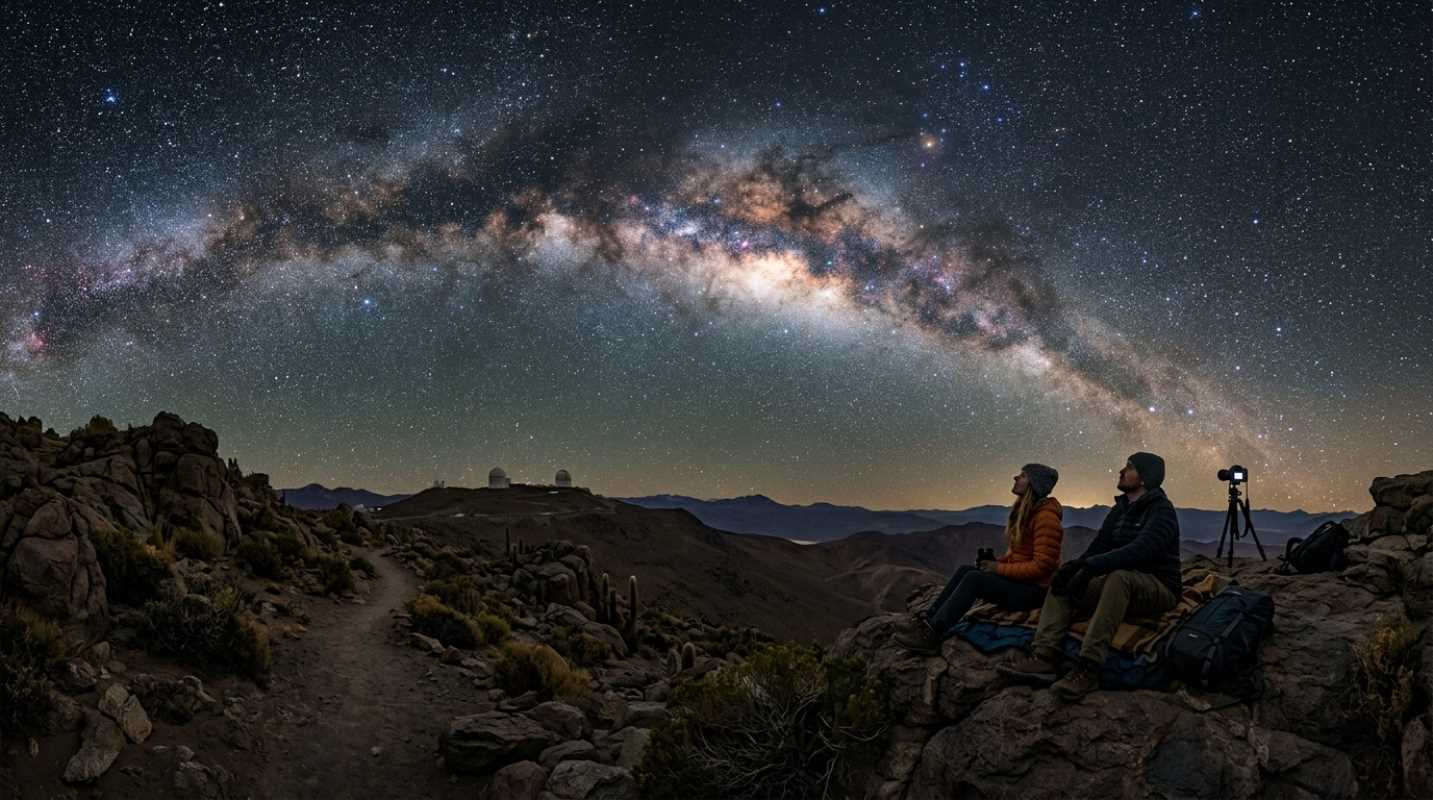
When was the last time you stepped outside at night, looked up, and actually saw the Milky Way? For most people living in modern cities, the honest answer is usually "never" or "not in years" anymore sadly.
Artificial light is filling up our night sky faster than ever before. Global light pollution is growing by roughly 10% every single year.¹ Today, more than 80% of the world population lives under light-polluted skies. If you live in North America or Europe, that figure rises to over 90%. That means millions of people grow up without ever seeing the cosmic dust of our own galaxy stretched across the blackness of space.
Because our daily lives are bathed in constant streetlights and LED billboards, more travelers than ever are turning toward "noctourism" and astrotourism. The desire to find pure, undisturbed night skies has turned stargazing into a multi-billion-dollar travel trend.² People are packing their bags and traveling to the furthest corners of the planet just to reconnect with the universe.
So where should you go if you want to experience total darkness and see billions of stars overhead? Let's walk through some of the most spectacular dark sky locations on Earth and how you can plan your own adventure.
Top Dark Sky Destinations for Stargazing
When you want to see deep space objects with your naked eyes, you need specific conditions: high altitude, low humidity, clear weather, and zero light pollution. DarkSky International certifies protected dark sky reserves around the world that meet these strict criteria. Here are four locations that stand at the very top of any star lover's bucket list.
Atacama Desert, Chile
The Atacama Desert is the driest non-polar desert on Earth, enjoying more than 300 clear nights every year. Because of its extreme elevation, thin air, and total absence of surface moisture, atmospheric distortion is virtually non-existent here. It is so dry and quiet that major scientific bodies built world-class facilities here, including the Very Large Telescope and ALMA. If you want unmatched clarity, this desert plateau offers some of the clearest conditions you will ever experience.
Aoraki Mackenzie International Dark Sky Reserve, New Zealand
Covering over 4,300 square kilometers across New Zealand's South Island, Aoraki Mackenzie is a prime location for southern hemisphere viewing. Standing near Lake Tekapo on a clear night lets you gaze directly into the core of our galaxy. You can spot famous southern targets like the Southern Cross, the Large and Small Magellanic Clouds, and occasionally the pink and green curtains of the Aurora Australis.
Jasper National Park, Canada
Located in the central Canadian Rockies, Jasper is one of the largest accessible dark sky preserves in North America. Unlike some remote research deserts, Jasper is easy to visit with family. You can stay in a comfortable mountain town during the day and drive out to glacial lakes at night to watch stars reflect across still waters. If you visit in late autumn or winter, you stand a high chance of catching brilliant northern lights.
NamibRand Nature Reserve, Namibia
Located in the ancient Namib Desert, NamibRand is recognized by astronomy experts as one of the naturally darkest places on Earth.³ Spanning around 200,000 hectares, this private reserve keeps light pollution to near zero. It offers a rare mix for travelers: you can spend your day tracking desert wildlife on safari and spend your night sleeping under a lot of canopy of stars.
Mastering the Calendar for Night Sky Viewing
Timing is everything when you plan a celestial trip. You could travel to the darkest reserve on Earth, but if you pick the wrong week, you might miss the star show completely.
First, you need to track the lunar cycle. Always plan your trip during the new moon phase, or choose dates when the moon sets early in the evening. A full moon acts like a giant light bulb hanging in the sky, reflecting enough light to wash out up to 90% of dimmer stars and deep-sky objects.
Second, consider the season for galactic core viewing. The brightest and most detailed center of the Milky Way is only visible during specific months of the year. In both Northern and Southern Hemispheres, the galactic core season peaks between April and October.
Finally, think about local air conditions. Cold winter nights and dry desert seasons usually yield much clearer viewing because cold, dry air holds less moisture and atmospheric movement. This gives you crisp, stable views of planets, double stars, and annual meteor showers.
Needed Tips for a Memorable Stargazing Trip
You do not need a multi-thousand-dollar setup to enjoy a night under the stars. But bringing a few basic items will completely change your experience.
• Use a red-light headlamp: Your eyes need 20 to 30 minutes to adjust to true dark vision. Standard white flashlights or phone screens reset this timer instantly. Red light wavelengths preserve your dark adaptation while allowing you to walk safely around camp.
• Bring binoculars first: Before buying a heavy telescope, start with a good pair of 10x50 or 7x50 astronomy binoculars. They offer a wide field of view, require zero setup time, and reveal sweeping views of star clusters and lunar craters.
• Pack serious thermal layers: Desert plateaus and mountain valleys freeze as soon as the sun goes down. Dress in warm layers, bring a windproof jacket, and pack a thermos of hot tea or coffee to stay comfortable during long viewing sessions.
• Download star charts in advance: Phone apps are great for identifying constellations, but cellular service is non-existent in dark reserves. Download star maps for offline use, and lower your phone screen brightness all the way down.
• Patience matters: Give yourself time to settle in. Sit quietly in a reclining camp chair, let your eyes fully adjust, and watch as hidden layers of stars slowly appear out of the darkness.
Your Personal Connection to the Cosmos
Stargazing is more than a fun weekend activity or a photo opportunity. Standing beneath an unbroken sea of stars produces a deep, humbling sense of awe that is nearly impossible to find in modern city life. It resets your perspective and connects you to something vast and timeless.
As light pollution spreads, protecting our remaining dark sky spaces becomes key. By supporting protected parks, using shielded amber outdoor lighting at home, and choosing eco-conscious dark sky destinations, you help keep these incredible windows into the universe open.
So turn off your screens, pack a warm coat, and head out into the dark. A whole universe is waiting for you to look up.
Sources:
1. National Geographic - A Practical Guide to Stargazing
https://www.nationalgeographic.com/travel/article/a-practical-guide-to-stargazing
2. Growth Market Reports - Astro Tourism Market
https://growthmarketreports.com/report/astro-tourism-market
3. Dark Sky Atlas - Best Dark Sky Parks in the World
https://www.darkskiesatlas.com/guides/best-dark-sky-parks-world